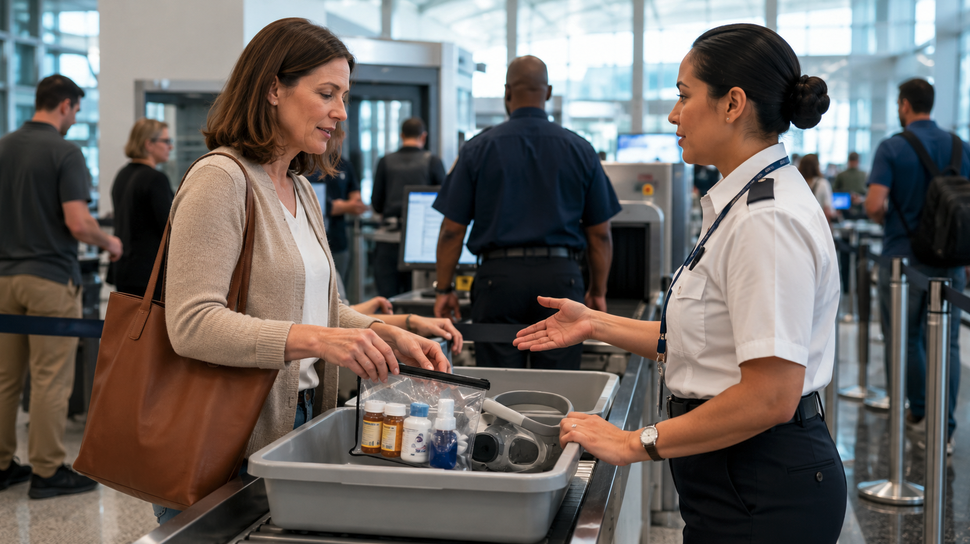
Most travelers know about airport security’s famous liquids rule.
In the United States, it’s TSA’s 3-1-1 rule. Many other countries have similar restrictions, limiting how much liquid you can bring through security in your carry-on.
But what happens if your medication doesn’t fit into a tiny 3.4-ounce bottle?
Fortunately, most countries have exceptions for medically necessary medications and equipment. The trick is knowing what the rules are before you get to the airport—and remembering that those rules can change once you leave the United States.
As many Americans know, when you’re traveling by plane in the United States, you’re required to follow the 3-1-1 rule: “you’re allowed to bring a quart-sized bag of liquids, aerosols, gels, creams, and pastes through the checkpoint. These are limited to 3.4 ounces or less per item.” (https://www.tsa.gov/videos/travel-tips-3-1-1-liquids-rule).
Although technology in some countries has allowed passengers to bring more liquids in their carry-on, it’s not yet international, and most countries still follow similar guidelines to us.
But if you have medications, especially if they’re in liquid form and take up more than 3.4 ounces, then what do you do? Well, in the United States, the Transportation Security Administration (T.S.A.) has got you covered:
Tell the security officer right away
If you’re traveling with medically necessary liquids, medications or medical equipment, tell the security officer before the screening process begins. That helps ensure the items are screened correctly and can prevent unnecessary delays.
If you’re traveling internationally
Once you leave the United States, TSA rules no longer apply.
Every country has its own regulations regarding medications, documentation and what can legally be brought into the country. Before you travel, make sure you understand the requirements for every country you’ll be visiting.
Here are a few examples:
United Kingdom
In the U.K., as per this page of gov.uk, you’re allowed to carry essential medications of more than 100ml in your hand luggage. Still, you’ll need supporting documentation from a relevant medical professional (i.e., a letter from your doctor or a copy of your prescription). The same goes for gel packs.
Australia
In Australia, as per this page of the Australian Government Department of Infrastructure and Regional Development, a reasonable quantity of prescription and non-prescription medication and equipment is allowed, and supporting documentation is required. Check the page for what is considered a reasonable amount.
Canada
In Canada, this page reviews Canadian policies of flying with prescription and essential non-prescription medications, medical items and mobility aids, and medical marijuana.
None of these pages mention what medications canNOT be brought into other countries. Still, you can check the Customs & Border Protection page of the country you’re visiting for clarification (i.e., it’s illegal to bring into Japan some over-the-counter medicines commonly used in the United States, including some inhalers and some allergy and sinus medications. Specifically, products that contain stimulants [medicines that contain Pseudoephedrine, such as Actifed, Sudafed, and Vicks inhalers], or Codeine are prohibited if it contains more than allowed quantity of stimulant raw materials).
Also check to see if you need to obtain a permit for bringing certain medications into certain countries.
Caveat: I realize there’s no guarantee that any given government worker will follow the rules exactly. I don’t know what happens in other countries, but I’ve read reports about how individual TSA workers will sometimes forget or eschew some regulations and make things difficult for travelers who have certain medical needs. But the above is what’s “supposed” to happen.
THIS NEXT PART IS IMPORTANT!
Regardless of where you’re traveling to/from, always, ALWAYS, ALWAYS carry your medications and medical equipment with you, preferably in your small personal carry-on item/handbag (so if you’re asked to gate check your carry-on luggage for some reason, you don’t have to worry that they’re going to lose all your meds or break your CPAP machine). Unless it’s a piece of equipment that won’t fit in your carry-on bag (even if your carry-on is empty), DON’T EVER PUT ESSENTIAL PRESCRIPTION MEDICATIONS OR MEDICAL EQUIPMENT IN YOUR CHECKED LUGGAGE. Equipment can be damaged in transit, and if your luggage is lost, you won’t have your equipment, or even more important, your medication, until it’s returned to you. If you figure that’s no big deal and you can just get a replacement of your prescription at the closest pharmacy, heads up that you may or may not be able to to do that – click here to read about that (Note: the advice is specifically if you’re traveling within the U.S.).
If your medication needs to stay refrigerated, check the rules for your destination before you travel. Many countries allow freezer or gel packs for medically necessary items, although documentation requirements vary.
Traveling with medication doesn’t have to be stressful.
A little preparation before your trip can save you a whole lot of headaches at the airport. Check the rules for every country you’ll be visiting, carry your medications with you—not in checked luggage—and keep any required documentation handy.
And if you’re ever unsure, don’t guess.
Check with your airline, the airport security agency or customs authority for the country you’re visiting before you leave home.
It’s much easier to spend a few minutes researching the rules than trying to sort everything out at the security checkpoint.
Happy—and healthy—travels!
Want to comment on this post? Great! Read this first to help ensure it gets approved.
Want to sponsor a post, write something for Your Mileage May Vary or put ads on our site? Click here for more info.
Like this post? Please share it! We have plenty more just like it and would love it if you decided to hang around and sign up to get emailed notifications of when we post.
Whether you’ve read our articles before or this is the first time you’re stopping by, we’re really glad you’re here and hope you come back to visit again!
This post first appeared on Your Mileage May Vary